The US dollar is not a wooden ruler. It’s not a fixed, permanent yardstick that’s used to measure what everything else is worth. A loaf of bread might cost $4, you might pay $3.50 for a gallon of gas, and Bitcoin might be traded for tens of thousands, but that’s not the whole picture.
In reality, there is no fixed yardstick. Value is never intrinsic to any object, and it’s never locked in stone. Value is strictly a comparative ratio between two things, and it’s driven entirely by human demand in a specific time, place and circumstance. Exchange rates, even between fiat currencies, are always changing.
Flip the Ruler Around: Value the Dollar in Slices of Toast
If you flip the ruler around, the way you look at dollars, groceries, and Bitcoin changes completely.
Since we price everything in dollars, it’s easy to forget that you can measure a dollar in everyday goods just as easily as you measure everyday goods in dollars.
Imagine a loaf of bread costs $4.00 and gives you 20 slices of toast:
- The Dollar Perspective: One slice of toast is worth $0.20 (20 cents).
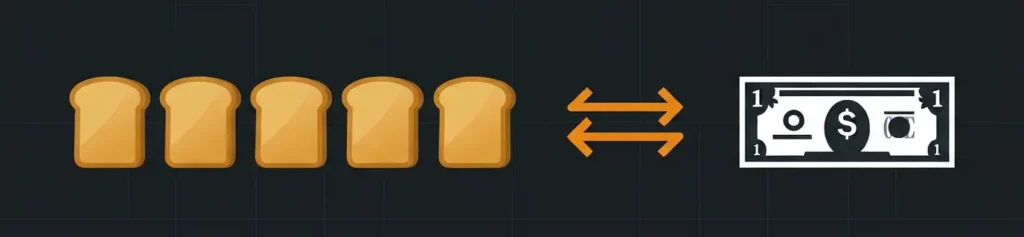
- The Toast Perspective: One US dollar is worth 5 slices of toast.
Fast-forward a few years after a mix of rising production costs and after heavy money printing pushes the price of that same loaf of bread up to $5.00. Most people will say, “Bread has become more expensive.” Yet when you look at the comparative opposite, you see the other half of the equation: relative to bread, your dollar lost 20% of its purchasing power. A dollar is now only worth 4 slices of toast instead of 5.
Neither the bread nor the dollar has an “official” value stamped into the universe. Value is simply the exchange rate between what you have and what someone else wants.
Cans of Soup, Computer Memory, and Cigarettes
Because value is driven by comparative demand, the “price” of anything depends entirely on what you compare it against, and who you’re trading with:
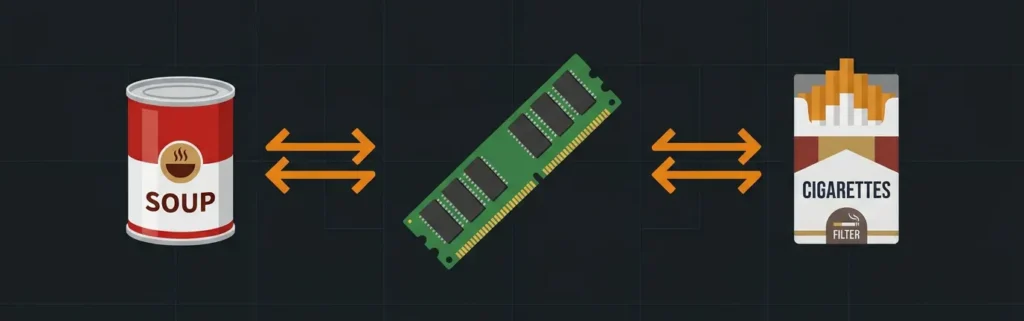
- At a Tech Swap Meet: A hungry and broke collector with spare parts might happily trade a stick of computer memory for a few cans of soup. In that moment, the value of soup is measured in computer memory, and the value of computer memory is measured in cans of soup.
- In a Wartime Prison Camp: Paper currency becomes completely worthless, while cigarettes often become the universal currency. A can of soup might be valued at three cigarettes, and a warm coat at fifty cigarettes. It’s not because tobacco has magical intrinsic value, but because demand is high and supply is scarce.
- During a Power Outage: A $100 bill won’t charge your phone or heat your dinner, but a $10 portable battery bank with a full charge suddenly becomes priceless.
Every trade in human history works the exact same way. Nothing has “intrinsic” value on its own—value only exists when human demand meets relative scarcity.
Why This Explains Bitcoin (And Silences the “Intrinsic Value” Myth)
Critics often claim that Bitcoin has “no intrinsic value” because you cannot eat it, you cannot wear it, or because you cannot melt it down like gold. Yet those same critics never stop to ask what “intrinsic value” a $100 bill or a digital bank balance actually has.
When you understand that value is always a comparative ratio driven by demand, four truths about Bitcoin become obvious:
- You Don’t Just Value Bitcoin in Dollars—You Value Dollars in Bitcoin: Most people watch Bitcoin’s price in dollars go up and down. They rarely flip the comparison around to see that over any multi-year time horizon, a single US dollar buys fewer and fewer satoshis (fractions of a Bitcoin).
- Fixed Supply Beats Infinite Supply: Every fiat currency has a central bank that continually expands the money supply. An expanding money supply constantly lowers what each dollar can be traded for in toast, soup, or housing. Bitcoin has a strict 21 million coin (21E6) hard cap, making it impossible to erode purchasing power through money supply expansion.
- Scarcity Plus Utility Equals Monetary Demand: People demand Bitcoin because it’s the only asset on earth that can be sent anywhere in minutes, that can be verified by anyone without permission, and that can be stored without a government or bank inflating away the supply.
- Bitcoin Demand Comes From Verifiable Rules, Not Blind Trust: With fiat currency, you are forced to trust politicians and central bankers not to print too much. It’s a promise that’s been broken every single time money has had a centralized authority. With Bitcoin, you don’t need trust at all: millions of people adopt and value Bitcoin because anyone can independently verify its programmed rules, its fixed 21-million supply cap and predictable issuance, or experience its borderless settlement that no single person or government can alter. That certainty in the code is what drives real-world demand, and it’s why people around the globe are willing to trade their toast, soup, labor, and dollars for it.
Want to see that comparative exchange rate play out in real numbers over a decade? Read our 10-Year US Dollar vs. Bitcoin Grocery Bill Test.
Represent the hard money standard every day with our Hard Money Mugs or be loud about sound money with Bold Bitcoin & Hard Money Apparel.