A lot of people assume currency collapses only happen in distant countries or in ancient history books. They rarely hear about what happened right next door to them—and well within living memory.
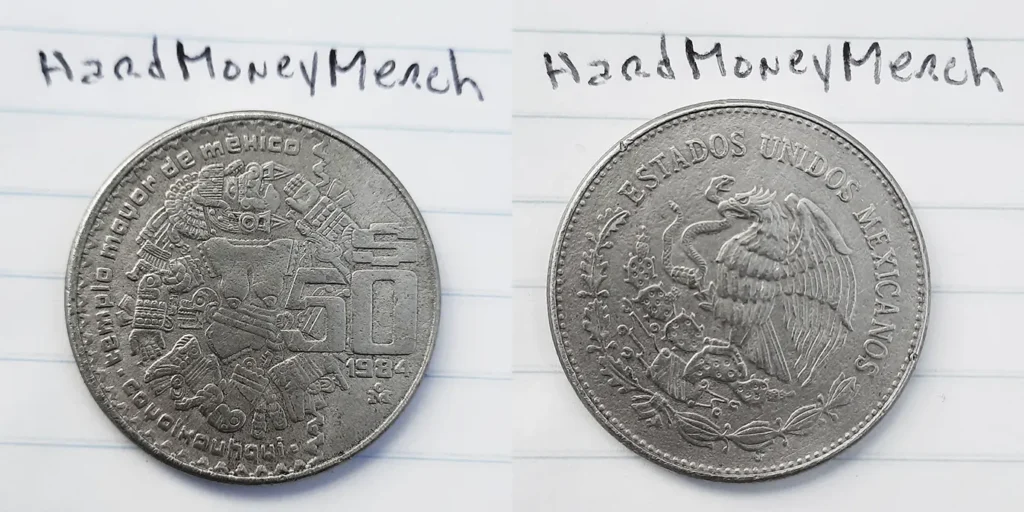
If you held an original 1984 Mexican 50 Peso coin in your hand, you’d be looking at a base-metal coin that lost 99% of its purchasing power in just 11 years before being stripped of all legal value. Its rapid rise and disappearance tell a clear story about what happens when money has no hard supply cap—and why Bitcoin was built to fix it.
Minted to Commemorate an Aztec Discovery and Then Overwhelmed by Inflation
Between 1982 and 1984, Mexico struck a very large 50 Peso coin made of copper and nickel. It featured an Aztec moon goddess who was depicted on a massive carved stone disk that was unearthed by electrical workers in Mexico City in 1978.
At nearly 1.4 inches wide—about 45% larger than a US quarter—and weighing about 0.7 ounces, the coin felt like substantial money. Yet 1984 was the final year this coin was ever minted. By then, Mexico’s runaway inflation was eroding its peso so rapidly that striking a large, heavy coin for a 50-peso denomination no longer made economic sense—the metal and minting costs were quickly catching up to the face value stamped on the coin.
From 50 Pesos to 5,000-Peso Grocery Coins
Once inflation accelerated, denominations spiraled into huge numbers in just a few years:
- Everyday Denominations Exploded: Within a few years of the 1984 50 Peso coin’s retirement, Mexico was minting 1,000-peso and 5,000-peso coins that could only buy bus fare, a few tacos, or a couple bottles of soda.
- Three Zeros Lopped Off Overnight: In January 1993, the Mexican government introduced the Nuevo Peso (“New Peso”), and sliced three zeros off the old currency overnight—turning 1,000 old pesos into 1 New Peso.
- Reduced to 5 Centavos—Then Demonetized: Overnight, the 1984 50 Peso coin became worth a measly 5 centavos (0.05 New Pesos). By November 1995, the coin was officially demonetized and stripped of all value.
The coin wasn’t gold and it wasn’t silver: it was just a base-metal token whose purchasing power vanished the moment the government printed too much of it.
What Mexico’s 1984 50 Peso Coin Shows Us About Bitcoin
Looking at how quickly a heavy, everyday circulating coin became worthless highlights three core reasons why Bitcoin matters:
- Physical Weight Does Not Make Money “Hard”: A coin can feel thick, heavy, and solid in your palm, but if it’s made of base metal backed only by government decree, its value can evaporate very quickly. Bitcoin’s scarcity comes from verifiable mathematical code, not metal weight and not promises made by a central bank.
- Inflation Always Escalates Until a Monetary Reset: Once a government relies on money printing to cover deficits, 50-peso coins turn into 5,000-peso coins—until authorities eventually lop zeros off the currency and wipe out the savers who thought they were being responsible.
- No One Can Lop Zeros Off Bitcoin: Bitcoin has a fixed supply cap of 21 million coins (21E6) that cannot be inflated by decree—that means that no government or central bank can ever devalue your savings into oblivion or declare your coins obsolete on a calendar deadline.
Want to see how a foreign power secretly printed another fiat currency from scratch? Read How the United States Secretly Printing German Currency Shows Us We Need Bitcoin.
Represent the hard money standard every day with our 21E6 Collection or browse original Bitcoin & Hard Money T-Shirts.